Sunday, 2 October 2016

Post 5 - Legal and ethical contexts in my digital practice

I started at my current school just over a year ago. Upon arrival in one of my classes, I was told by the teacher temporarily looking after what was to be my classes until my arrival that my students had already checked me out on social media, and had a basic idea who I was. My first thought was "where and how did they find me?" quickly followed by "what did they find?" In answer to the first question, anything from Twitter (the actual culprit), Google+, Blogger, Instagram, Pinterest or Facebook? I knew that personal stuff was all locked down in Facebook (nothing more than a few rants and a couple of swear words in all honesty...) and that my digital footprint was relatively clean. So they found out I have a campervan, am a Science teacher, a Google geek, cat mad and a vegan. Nothing I don't tell my classes in that getting to know you phase at the start of the year. Phew.

Image result for social media
It could have been so different. Had I been a party animal (I'm not!) or done some things that were a tad dubious, posting them online could have been quite problematic. 

Using Social Media with students raises even more ethicla issues. There has been extensive coverage in the New Zealand Herald recently about an inappropriate online and real - life relationship between a teacher and 13 year old female student that ended very badly. Much of this relationship was maintained on social media. This digital communication has been used extensively in court as evidence in this case, clearly breaching the Education Council Code of Ethics for Certificated Teachers (n.d.) across all sections. 
We strive to make our students 21st Century leanrners, connected and collaborating, communicating globally, sharing their learning far and wide. This means the use of Social Media platforms, where potentially a teacher's personal and work lives can become entangled. However, these tools really lend themselves to moder education, and the advantages are often far outweighing any negative aspects.
Some of the issues that are caused through this use of Social Media include 'friending' students on Facebook etc. This means students then have access to everything the teacher does, and vice versa. As students really don't want teachers to know what they have been up to (particularly in the secondary level) it is not appropriate for students to know what teachers are up to either. Teachers (and students) should be very aware of locking down profiles that are personal to the nth degree. A good starting place for information on this would be the Education Council website 'Teachers and Social Media'. 
Hall (2001) discusses how to approach ethical issues to find an answer that is ethically acceptable, and also raises the issue of professionalism - "What would happen if everyone did that?" Does what a person is doing look bad to the students, whanāu, community or profession or cause doubt about the professional competency of the teacher? It is always best to stop and think about it a minute, before becoming yet another headline in the Herald about teacher misconduct. We need to ensure professional distance in our communications with students at all times. The boundaries are increasingly blurred with digital technologies, and it is prudent for a school to consider creating a policy document to guide staff in these matters (Henderson, Auld &Johnson, 2014; Ministry of Education, 2015). This is something we are in the process of considering as more teachers make sue of social media to communicate with students, gratifying that need for immediacy that is a feature of our learners' lives. 
It is good practice for teachers to think about what they share online, especially if it is accessible by students (believe me they WILL find it, if public), but also to ensure privacy settings are set as high as they can for personal accounts. Be aware your audience may include students, whanāu, the wider community, or yoour potential future employer! Remember the internet has a persistence that remains long after the hangover has worn off...
References
Code of Ethics for Certificated Teachers | Education Council. (n.d.). Retrieved October 2, 2016, from https://educationcouncil.org.nz/content/code-of-ethics-certificated-teachers-0
Hall, A. (2001). What ought I to do, all things considered? An approach to the exploration of ethical problems by teachers. IIPE Conference for Ethics, Law, Justice and …. Retrieved from http://www.educationalleaders.govt.nz/content/download/545/4465/Hall 2001.pdf
Henderson, M., Auld, G., & Johnson, N. F. (2014). Ethics of teaching with social media. In Australian Computers in Education Conference 2014, Adelaide, SA. Retrieved from http://acec2014.acce.edu.au/session/ethics-teaching-social-media
Ministry of Education. (2015). Digital technology - Safe and responsible use in schools. Retrieved from http://www.education.govt.nz/assets/Documents/School/Managing-and-supporting-students/DigitalTechnologySafeAndResponsibleUseInSchs.pdf


MindLab 4 - Indigenous knowedge and cultural responsiveness

Image result for cultural responsiveness
The school I work at has a large percentage of Māori students, although Europeans / Pākehā make up the majority of the students. (Stats taken from the ERO website, last inspection May 2016).
In a video about Culturally Responsive Pedagogy, Professor Russell Bishop discusses 6 factors that agentic teachers, those who reject the deficit theory (defining Māori students by their weaknesses rather than their strengths) use regularly in their classrooms. For brevity, these are not going to be specifically discussed here, but are mentioned in the video. However, I can honestly say that these have pointed out areas for my personal improvement in my interactions with Māori students, especially around the co-construction of the learning and use of Māori concepts in teaching and learning. Sometimews we all get so bogged down in the stuff we have to teach (yes, even to the extent of making sure students pass the test...) that we forget to make the real connections that have the best outcomes. One thing I have learned personally, is that the relationship with the students is THE most important thing to achieve. I use humour, eye contact and am non-judgemental about ability based on race, but still could be doing more for my Māori ākonga. Something to focus on in 2017 more.
Vision, mission and core values
Our mission is about creating outstanding young women, who will leave the school well prepared for the next step of their lives as positive contributors to the NZ society. Our motto is "Whakamana ngā wāhine o apōpō - Empowering Tomorrow's Women".
We have vowed to embrace the unique position of our Māori culture, value NZ's cultural diversity, and focus on realising the potential of Māori and other priority learners.
Our values are put together in the Fideliter Code: Mahi tahi (working together), Kia kaha, kia toa (giving our best), Tika me te pono (having integrity) and Manaakitangata (showing respect).
From my perspective as a teacher who has only recently arrived at the school, we appear to be doing quite well at these aspects and this is echoed by the favourable ERO report in 2016. The school is on a path of becoming more culturally repsonsive, working with the Māori leaders to undersatand our biculturality better. Our learners asked us to do this, as they saw their peers leaving school early and dropping by the wayside. The shift towards inclusivity and a Cuturally Reflective Pedagogy has 'snowballed' this year, with initiatives being instigated to really connect with our Māori ākonga and encourage their development, so they feel included and valued.
One of our goals as a school is about changing outcomes for our Māori ākonga, including improving retention of Māori students across all levels, improving their achievement at all levels and making stronger relationships with whānau to support the achievement of individual students and identified groups.
As with all goals, this is a work in progress, but we are making progress. That said, there is never room for complacency, so this goal continues into next year and beyond. There is a move to strengthen the relationships between school and whānau, and support is growing for us in working with the ākonga. Personally, as mentioned above, I need to use more of the experiential learning that comes with each student and feel that this may be the case among some of my peers. Also, specifically within the Science department (I cannot speak for others) there is only latterly a move towards more cultural inclusion in the senior Science areas. The junior curriculum has some aspects of Māori culture (Mataraiki, for example), but this does not extend as well into the senior school. Clearly to help retain our Māori students, we need to be addressing the shortfall in this area. The school goals filter down to department level, and we acknowledge things could be better, but change is happening, and for the right reasons - Empowering Tomorrow's Women.

MindLab post 3


He hono tangata e kore e motu; ka pā he taura waka e motu (Material bonds can be broken; but human bonds endure)

My next post is an issue facing everyone, not just education - sustainability, as identified by CORE as one of their ten trends for 2016. It was also identified in the NZ Curriculum document (MoE, 2007) as a value that we expect a typical New Zealand student to have once they complete their education.

Sustainability has been a keystone of my life, having been involved in many environmental projects. I was first introduced to environmentalist thinking and action by a lecturer at tertiary college who showed me what it means to be an activist for the planet, something I embraced and continue to embrace.
I am a Science educator, but I also have a strong interest in protecting the environment and encouraging students to consider the consequences of their actions on the planet. One of my (minor) actions was creating the Google+ community for NZ EfS teachers.  I believe sustainability to be an interest that crosses all curricular boundaries and can be incorporated into most areas of learning. Nonetheless, Education for Sustainability (EfS) is now a Science subject.

One of the main issues discussed in relation to sustainability is the effect of climate change on the planet (or more specifically anthropogenic climate change), particularly within the Pacific region where Kiribati and Tuvalu are approaching the point of disappearing under the waves due to rising sea levels (Morton, 2016).


Other issues that are also equally important are the uses of resources closer to home, such as depletion of fish stocks and pollution of our waterways by industry and agriculture. These are issues that can be discussed with classes of students. CORE recommend that students are also shown how to take action over issues; something I have long promoted and continue to promote, both in the classroom and outside of it. 


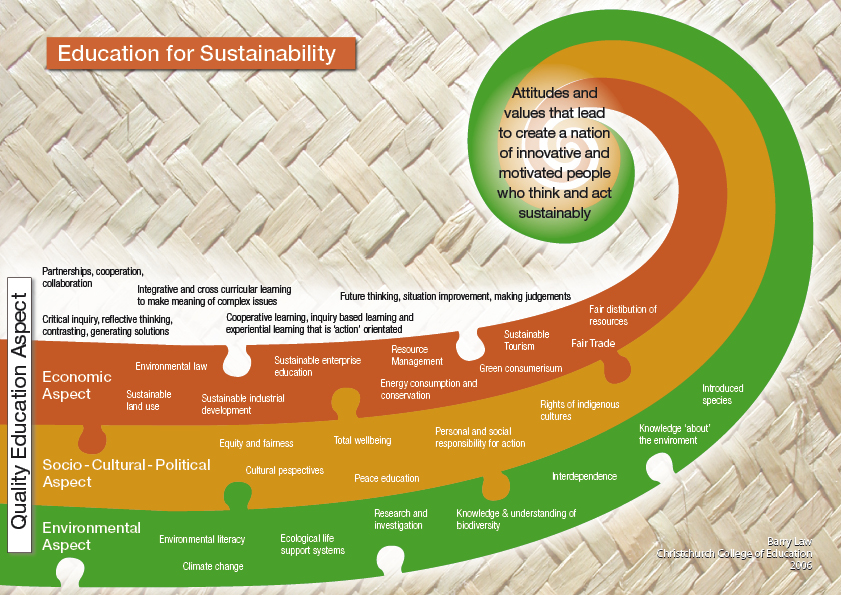
This diagram shows what the goals of EfS are, and show the inter - connectedness of society as well as education in sustainability. 
CORE have also identified that as a result of the access to technology that students now have, they are better able to connect with other students around the world or source information about issues. Part of the role of the teacher, therefore, could be to help students navigate this huge wealth of sometimes not too truthful information. The New Zealand government and various powerfully rich mining companies would have us believe that fracking is not likely to cause any issues around our shores. As Tui beer would say, Yeah, Right.
As educators, we can encourage students to become more active for the planet. More schools should be encouraging students to focus on the small stuff and  see how this feeds into the big stuff. 

Currently, EfS is not as prominent in the NZC as many educators would like, and is not even a compulsory strand, rather a recommendation (Eames, Cowie and Bolstad, 2008). There is a wealth of information available to all teachers, to assist in the implementation of sustainability education, especially in New Zealand where we have resources and guidelines available through TKI. The day will come when all educators play a part in educating students about the environment and sustainability, but for the moment I am happy to be part of the vanguard!

References.

Eames, C., Cowie, B., & Bolstad, R. (2008). An evaluation of characteristics of environmental education practice in New Zealand schools. Environmental Education Research, 14(1), 

Ministry of Education. (2007). The New Zealand Curriculum for English-medium teaching and learning in years 1–13. Wellington: Learning Media.

Morton, J. (2016). Pacific nations desperate for climate action - Climate Change - NZ Herald News. Retrieved October 2, 2016, from http://www.nzherald.co.nz/climate-change/news/article.cfm?c_id=26&objectid=11591295


Thursday, 22 September 2016

2 of 5 Mindlab posts - A reflection on the socio-economic status of my school

The school I work at is a single-sex, decile 5  school (based on an outdated set of criteria defined by the Ministry of Education). We have students classed nationally as "in the middle". The reality is actually not quite so simple; we have students who come from socio-economic backgrounds that can only be described as bordering on poverty and students at the other end of the scale. The reason for the disparity (as well as the very middling decile rating) is coming from a small city with big agricultural catchment, there is a diverse range of students attending the school.

Māori students account for 35% of our roll, with the majority being Pākehā. We have been working to become more culturally responsive, with initiatives such as inclusive professional development and the creation by students of a new karakia - Te Timitanga. Stoll (1998) discusses how "pupils who attend the school flavour it in their own particular way, through their own pupil culture", and this is ably demonstrated by the drive from the students to be more culturally responsive.

Our school motto is "Whakamana ngā wāhine o apōpō - Empowering tomorrow's women" and this encompasses our philosophy, which is about "preparing girls to be outstanding young who leave us ready for the next step in their lives" (taken from the school mission statement).
We are working to raise Māori achievement across all levels of the school with a move towards more student - centred learning. There is already a better connection between students, teachers and whānau with more communication, encouraged through conferencing during the year. Students are all in vertical whānau classes, allowing older students to be 'big sisters' to the younger girls.

We are striving to incorporate more 21st Century learning, collaboration and the use of digital technologies across the school. Stoll also talks about the difficulties of trying to make changes in schools, and while our school is receptive to change, there is still a contingent of staff that might resist change. This will undoubtedly become apparent in 2017 when we bring in a BYOD policy. Some teachers still believe in a teacher - centred approach will and this kind of programme will shift the focus from a teacher - led to student - centred learning and teaching style.

Another issue arising with BYOD is that students who are at the lower end of our socio-economic scale may be disadvantaged as they are less likely to be able to afford devices, and there will also be a chance that they do not have access to the internet at home, thus widening the gap between the 'haves' and the 'have-nots'. The school has some plans to assist with these issues, but we acknowledge that the issue exists. No implementation can ever go without "selling the idea to get people on board" (Thirkell and Ashman, 2014), something that probably needs to be done more with the staff than the students, but as someone once said, "I never once had a student tell me they couldn't use technology because she didn't receive PD for it".

Overall, the school wants to see all students cared for and learning in a modern and vibrant environment, and I love being part of the team that are trying to push things forward. The traditional top-down leadership approach has started changing so that staff who are on the 'bleeding edge' of changing to encompass 21st Century learning skills are being encouraged to take some of the leadership roles. The school is moving forward, and the students are an integral part of this; they are the reason we are there, after all.


Thirkell, E., & Ashman, I. (2014). Lean towards learning: connecting Lean Thinking and human resource management in UK higher education. The International Journal of Human Resource Management, 25(21), 2957–2977. http://doi.org/10.1080/09585192.2014.948901


Sunday, 4 September 2016

Reflections on (one of) my Communities of Practice


My personal learning journey sees me involved in a lot of CoPs; each one determined by the shared goals of that community. The community that I feel I interact with mostly, is the Science department I as a part of. We meet approximately fortnightly, with a shared interest in the promotion of scientific thinking within our students to encourage a level of Citizen Scientific Literacy, as described by Gluckman (2011).

A Community of Practice (CoP) has been defined by Wenger (2000) as "communities that share cultural practices reflecting their collective learning". He also points out that participation in these communities is essential to learning.


The focus of the Science department is to raise critical thinking within our students; making them question the world around them and hopefully, learn to understand information presented as scientific to them on a daily basis. We are attempting to focus more on the inclusion of the Science Capabilities as well as the Nature of Science strands of the NZ Curriculum, making the students' learning more about the act of 'doing Science' rather than just completing practicals and writing notes because it is necessary for an exam or test (Haigh, France and Forret, 2005).

Image result for science nzThe department has spent a lot of time in critical reflection so far this year, as it was realised we are too assessment-heavy across all sections of the Science department, and our students are not getting the benefits of the accumulated knowledge and experience that the teaching staff have to offer. Our reflections have led us to understand that to really move forward and encourage scientific thinking is to make some big changes to the way we assess. This has not been easy, as all Communities of Practice can get bogged down over time, and sometimes need a real boost to get them moving in the right direction once again. From a personal point of view, this has been something of a revelation, but I am conscious of the stress this causes colleagues as sometimes making big changes is not easy, but as Wenger points out, gaps in the learning must be recognised and addressed.

I am part of the leadership team for the department, and am helping to drive some of the new ideas, making sure my colleagues are feeling supported, and also letting them know that it is acceptable to make mistakes and that by streamlining our processes, we will be clawing back precious time and seeing less stress among each other and our students. We are all learners on the journey with our students, and if we are afraid to make mistakes how can we encourage them to learn through making their own mistakes?

It is all a work in progress. Clearly, practices that we want to change have been long ingrained, but things must change. Otherwise, we can't enjoy our teaching of science, and there is no way we can get our students to develop the love of learning in science either. Thankfully, as a community, we have identified the issues and are working to move forward together, for ourselves and primarily for our students.

A journey of a thousand miles starts with a single step - Lao Tzu

References:

Gluckman, P. (2011). Looking Ahead: Science Education for the Twenty-First Century A report from the Prime Minister ’ s Chief Science Advisor.

Haigh, M., France, B., & Forret, M. (2005). Is “doing science” in New Zealand classrooms an expression of scientific inquiry? International Journal of Science Education, 27(2), 215–226. http://doi.org/10.1080/0950069042000276730 

Wenger, E. (2000). Communities of Practice and Social Learning Systems. Organization, 7(2), 225–246.


Thursday, 31 March 2016

Mindlab week 3 reflections

So, week 3 of the MindLab done, only 13 to go...

Yesterday was an inspiring session. For a start, the only video we had to make was about 20 seconds long and didn't involve scripts or Movie Maker. More on that later.

We were mainly focusing on AR and VR, both of which I find very interesting and potentially useful. There were several apps we downloaded including Enchantium, Anatomy4D, Cardboard, Aurasma and Quiver - each uses some kid of trigger. A bit about each:

Enchantium - using three discs of old maps and compasses, make sure the volume is on for this one. It creates sounds as well as the lights in between. Cool, but limited. I haven't thought of an educational application for this yet. If anyone comes up with an idea, I'll be pleased to hear it!


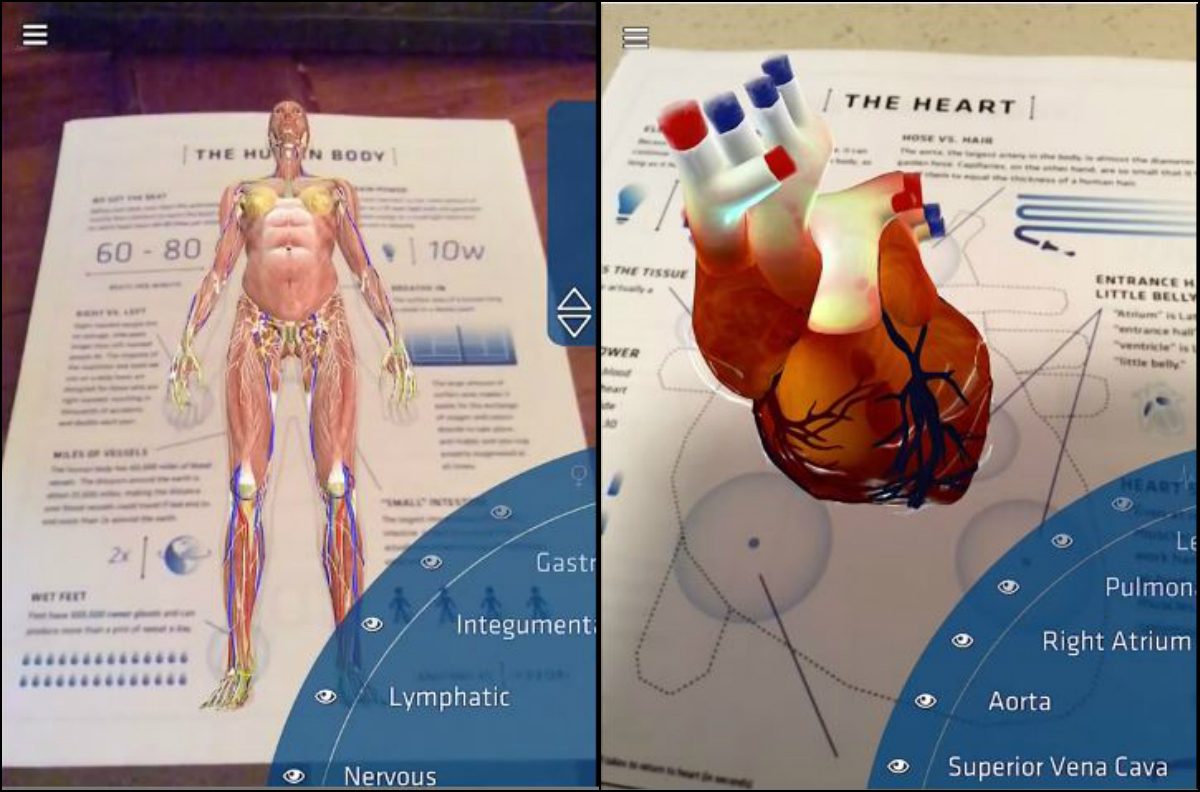
Anatomy 4D - what can I say? Wow. This is mind-blowing. I have already shown this to my classes, and the kids found this awesome. I need to get a student - sized print of the human body, so we can get a student to stand in front and superimpose the overlay on them... We have just covered body systems with one of my y11 classes, so this was interested to see this. Another class are just doing muscles and skeletal systems, so it was interesting to them too! Being able to move around the bodies and change the layers and details is fascinating, and seems to be very anatomically correct. The heart was also really cool; you can see the blood flow as well as removing bits and stripping things back. I need to find more of the print-outs - I suspect money may have to change hands... I can only find these two as freebies. Through playing with these images I found Element 4D, which I need to play about with a bit more, but it allows you to look at elements in 4D. There are a huge number of possibilities for these in my science classes.
Google Cardboard - the budget cardboard VR headset that has taken the world by storm. There are plenty of people who have posted about Cardboard, and there is a multitude of apps to go with it. My advice, start with the official Cardboard app from Google. Other ones I like, Star Wars (get a look around Jakku), Caaaaardboard (jumping off a tall building) and Cedar Point Roller Coaster (best viewed standing up, following the tracks).


Aurasma - this is another AR app that allows you to bring images to life. We were tasked with creating an Aura trigger (I used an Androidify image of myself) and a 20-second video as an introduction that was set off by the trigger. Mine was, quite frankly, crap. But it was a start. I have been following the Mindlab on Aurasma for a few years; since being shown it by Russel Dunn at Tamaki College, and now I am really starting to see possibilities for this app. Imagine a whole periodic table where a student can scan the element name, and watch a short video about the element. That's a plan for my classes...

Quiver - another potential game-changer. The app picks up any colours you add to the pictures (and there is even a book of NZ birds), and the image moves and can be interacted with, as can be seen from the image of the human cell.
I aim to spend some time and money getting some more of the sheets, especially the NZ birds, once coloured, they walk around! I need to find applications for this one too. Clearly the cell could be a good discussion starter with biology classes.

Clearly I need to dig into all of this more. Some of it is gimmicky, but give it time. I can see potential, and may need to implement some of these tools into my classes. A lot of these apps have real possibilities in science and biology, but think of all of the applications across other subject areas: art, technology, geography, history; with a bit of thought, it could be used anywhere in the NZ curriculum.

All in all, some very cool learning, and I actually got quite excited about the stuff we found out about. Here's to more cool learning from the #MindLab, and ways to integrate some of this learning into my teaching and learning. Awesome. It has also meant a created a second blog post in the same month!


As a footnote; my students have all been into their own AR app - Face Swap. This is incredibly freaky; if you haven't seen it, it is one way to do this:
My kids love doing this with my classroom skeleton...


Wednesday, 23 March 2016

MindLab first couple of weeks March 2016


I have been interested in the MindLab course for quite a while now; it never hurts to keep learning. Having said that, it is another workload that I have inflicted upon myself while still teaching full time. I must be mad...

I like the idea of being challenged, and what I learn should hopefully be transferable to my classes, despite our serious lack of reliable devices my classes have access to. I have already stepped right out of my comfort zone and created Microsoft Class Notebooks for all of my classes and used it for a collaborative task with 2 Y10 Science classes. I have never been a Microsoft fan and this has challenged me to learn (very quickly it would seem) how OneDrive etc works. Surprisingly, I am finding I am actually enjoying it...

This is going to be an interesting year... Hopefully I will be updating this often enough to be able to reflect on my learning and influence my teaching practice!